Quick Answer: How Do You Calculate Tile?
To use a tile calculator, multiply the length and width of your space in feet to find the total square footage, then divide that total area by the square footage one tile covers. Round up and add 10 to 15% for cuts and waste, or 15 to 20% for diagonal layouts and complex patterns. Convert the final tile count to full boxes, since tiles ship in boxes with fixed coverage. Cavastone’s tile calculator tool helps estimate quantities to review with your installer before placing an order.
Want a second set of eyes on your numbers? Our team confirms coverage and box counts before you order.
The fastest way to calculate tile quantities for a floor or wall is to use one calculation formula, and it works for every material in our Porcelain and Natural Stone catalog. The tile calculator formula is the total area divided by the tile area, plus a sensible cushion for cuts (10 to 20%). Order too few tiles and you risk a stalled tiling project and a lot that no longer matches. Order far too many, and the surplus sits in your garage for years.
This guide walks through the same method our showroom team uses with architects, builders, and homeowners across South Florida, step by step and with real numbers.
What You Should Know Before You Start
How accurate do my measurements need to be?
- Measure to the nearest inch and always at the widest points of the room.
- Measure twice. A half-foot error on a 12-foot wall throws off the whole order.
- A laser measure earns its keep on rooms over 15 ft and on tall walls.
Should I choose the tile before I calculate?
- Yes. Tile dimensions drive the total tile count, so settle the format first.
- Compare sizes and shapes in our guide to tile shapes, sizes, and combinations.
- Confirm the exact box coverage for your chosen tile. Box size varies by product.
How much extra tile should I plan for?
- Add 10 to 15% to the base count for cuts, breakage, and fitting errors.
- Diagonal layouts and intricate designs need 15 to 20%.
- Keep a few extra tiles after the job for future repairs and replacements.
Do floors and walls use the same method?
- The same method of tile calculator applies: area divided by tile area, plus a wastage allowance.
- Walls add one step. Subtract the area of windows and doors before you divide.
- For showers, calculate the area of each wall separately, then add the results.
10 to 15%
Standard extra tile calculated for cuts and waste
144 sq in
The area of one square foot
25 tiles
Cover 100 sq ft at 24 x 24 inches
33%
Max offset for large format patterns
In this guide
- Measure Your Space and Find the Total Square Footage
- The Tile Calculator Formula for Tiles Needed
- How Tile Size Changes the Total Tile Count
- How Much Extra Tile to Order for Waste and Cuts
- How the Tile Calculator Works for Walls and Shower Installations
- Turning Your Tile Count Into Boxes and Cost
- Why Extra Tiles From the Same Lot Matter
- Why Cavastone
- FAQ: Common Tile Calculation Questions
Measure Your Space and Find the Total Square Footage
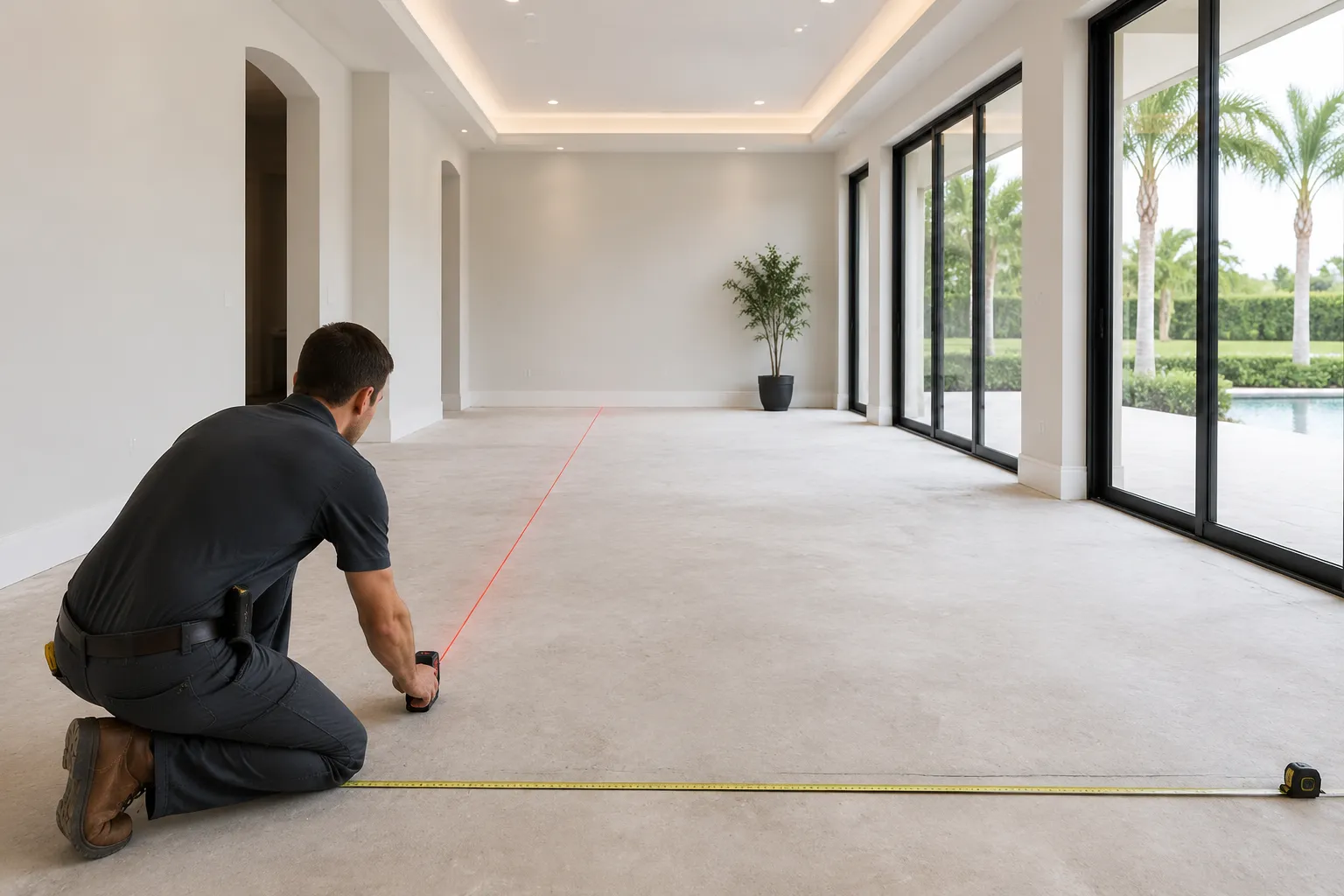
Every accurate estimate starts with the floor area. Measure the length and width of the room in feet, then multiply the two numbers. A 12 ft by 10 ft room gives you 120 square feet of floor space to completely cover.
Rooms rarely cooperate with clean rectangles. For an L-shaped kitchen or a bathroom wrapped around a vanity, divide the space into smaller rectangular sections. Measure each rectangle, work out its area, and add the results for your total square footage. The approach handles alcoves, hallways, and uneven surfaces without guesswork.
Pro Tip
Sketch the room and write each measurement on the sketch as you go. When a construction project changes midstream, the sketch lets you re-run the numbers in minutes instead of re-measuring the whole space.
The Tile Calculator Formula for Tiles Needed
With the room size in hand, the core calculation formula is simple. Divide the total area you plan to tile by the area of a single tile, and you have your base count.
Tile Calculator Formula: Room Area ÷ Tile Area = Number of Tiles
Tile dimensions usually come in inches, so convert first: One square foot = 144 square inches. A 12 x 24 inch tile covers 288 square inches, which works out to 2 square feet per tile. A 120 sq ft room needs 60 of them before waste. Swap in a 24 x 24 inch tile converted to 4 square feet each, and the number of tiles needed drops to 30.
Always round up to the next whole tile. You cannot install nine-tenths of a tile, and rounding down guarantees you run short. Grout lines nudge the math a little too, since each tile plus its grout spacing covers slightly more area than the tile alone. Grout joint guidance from the Tile Council of North America ties joint width to the tile type, with sanded grout for joints of 1/8 inch and wider. Treat any coverage gained from grout lines as a bonus, not a plan. Waste from cut tiles outweighs it on nearly every job.
Good to Know
Rectified tiles have precisely machined edges, which allow tighter grout lines and a near-monolithic look. Calibrated tiles vary a touch more in size and want wider joints. The choice changes the finished look far more than it changes the total number of tiles needed.
How Tile Size Changes the Total Tile Count
Tile size directly shapes how many tiles you need. Larger tiles cover more area per piece, which reduces the total count, speeds up installation, and cuts down on grout lines. Smaller tiles and mosaics flex around curves, drains, and tight corners, but they raise the count and the labor.
| Room Size | Tile Dimensions | Base Count | With 10% Extra |
|---|---|---|---|
| 100 sq ft | 12 x 12 in (1 sq ft) | 100 tiles | 110 tiles |
| 100 sq ft | 12 x 24 in (2 sq ft) | 50 tiles | 55 tiles |
| 100 sq ft | 24 x 24 in (4 sq ft) | 25 tiles | 28 tiles |
| 100 sq ft | 24 x 48 in (8 sq ft) | 13 tiles | 15 tiles |
The base count tells only half the story. Larger tiles generate more waste at the edges because every trimmed piece removes more material than a cut on a small tile. Oversized formats also demand a flat substrate. Our large-format tile guide covers where the big formats shine and what they ask of the installer.
Choosing the right tile size means weighing the room size against the effect you want. A 24 x 48 inch porcelain floor makes a compact living room read larger. A 12 x 24 inch field with a mosaic border gives a bathroom rhythm and grip underfoot.
How Much Extra Tile to Order for Waste and Cuts
No tiled surface installs without cut tiles. Perimeter rows, corners, outlets, and floor drains all take trimming, and some cuts break tile. The industry answer adds a wastage allowance of 10 to 15% on straight layouts, rising to 20% for complex layouts.
| Layout or Situation | Wastage Allowance | Why It Differs |
|---|---|---|
| Straight lay, open floor | 10% | Fewest cuts, mostly full tiles |
| Room with many corners or fixtures | 15% | More perimeter cuts around obstacles |
| Shower installations and backsplashes | 15% | Small planes, plumbing cutouts, trim edges |
| Diagonal layouts | 15 to 20% | Every border tile needs an angled cut |
| Herringbone and complex layouts | 20% | Intricate designs multiply the cut tiles |
| Natural stone with strong veining | 15% or more | Extra pieces let you blend variation |
Your tile layout drives the biggest tile calculator swings. Diagonal layouts force an angled cut on every border tile, and herringbone compounds the cutting further. Offset patterns carry rules of their own. The Ceramic Tile Education Foundation points to the ANSI A108.02 standard, which recommends a maximum 33% offset for large-format tile to limit lippage across the finished floor. Explore what each pattern does for a space in our look at tile layout patterns resource.
Watch Out
Under-ordering costs more than over-ordering. If your first order runs short, the replacement tiles may come from a different production lot with a visible shade shift, or the line may have sold out entirely. Buying enough tiles once, from one lot, protects the whole installation.
How the Tile Calculator Works for Walls and Shower Installations

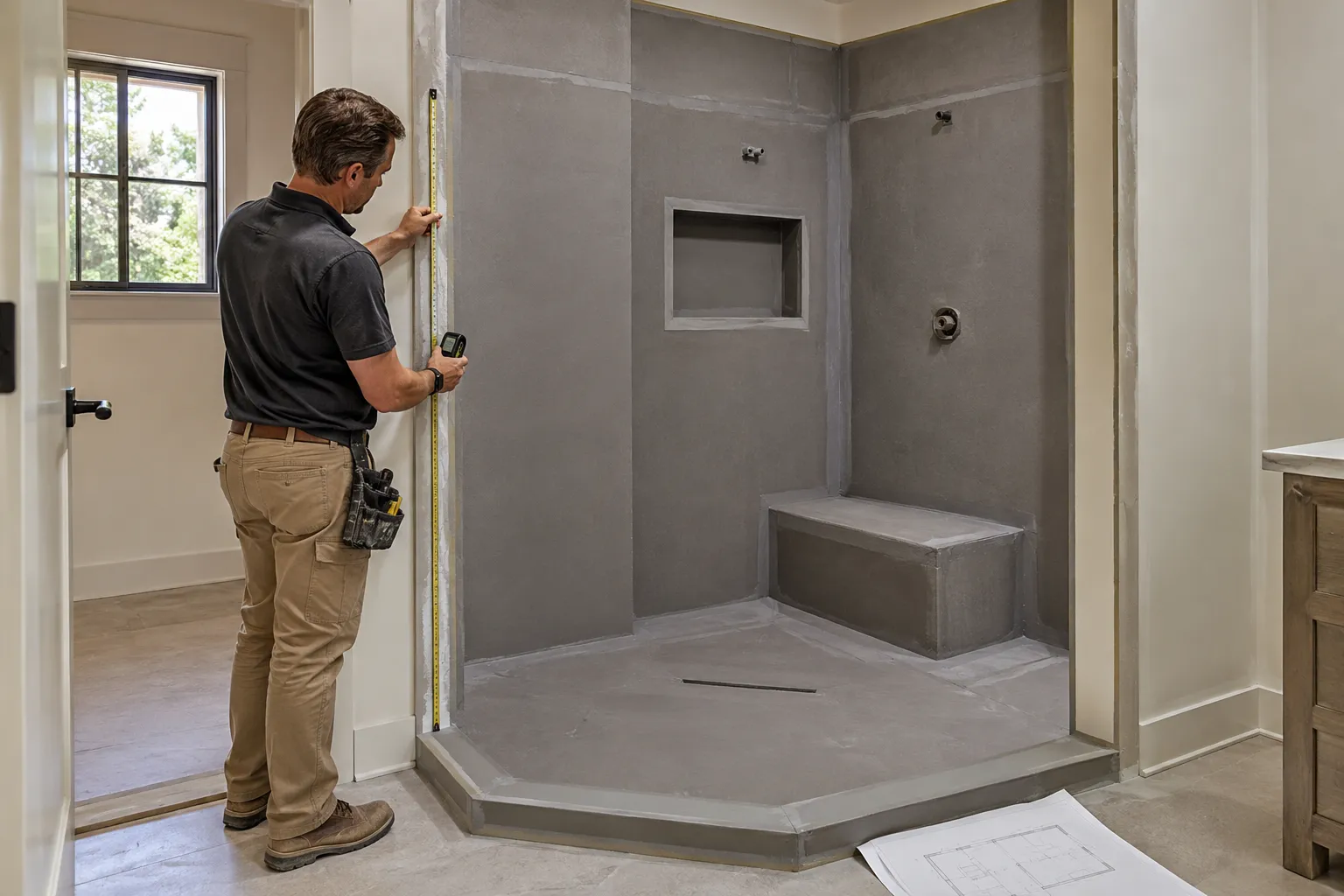
Vertical applications follow the same method to calculate tiles needed, but with one added step. Measure the height and width of each wall, multiply the two dimensions, then subtract the area of windows, doors, niches, and any zone you plan to leave untiled. What remains is the true area for that wall.
For shower installations, calculate the area of each wall separately and add the results. Showers punish shortcuts. Plumbing cutouts, benches, and trim edges all add cut tiles, which is why vertical work carries a 15% allowance rather than 10%.
- Run a sanity check on the arithmetic. A negative value after subtracting openings means a measurement slipped somewhere. A positive value confirms the tiled surface is real.
- Smaller tiles handle uneven surfaces and tight framing better than oversized formats.
- Wall tile and floor tile carry different ratings, so confirm that the tile type suits the plane. Our small bathroom tile patterns guide shows how pattern choice changes a compact room.
Turning Your Tile Count Into Boxes and Cost
Tiles typically come sold by the box, with each box covering a fixed number of square feet. Divide your total tile count by the tiles per box, then round up to full tile boxes. A 120 sq ft floor in 24 x 24 inch porcelain tile needs 33 tiles with 10% extra. At 4 tiles per box, that means 9 boxes, not 8.25.
Tile cost follows the same math. Multiply the total square footage you are ordering, extras included, by the tile price per square foot. A 132 sq ft order at $6 per sq ft comes to $792 in material. Add setting materials, grout, and labor separately, since those factors affect the project budget as much as the tile itself.
Once you understand the hand method, a tile calculator becomes a genuine time saver. Our Cavastone tile calculator takes your room dimensions, tile size, and waste percentage and returns the tile count in seconds. It doubles as a quick tile cost calculator when you know the tile price, and it gives you a clean tile estimator baseline to review with your installer before ordering.
Why Extra Tiles From the Same Lot Matter
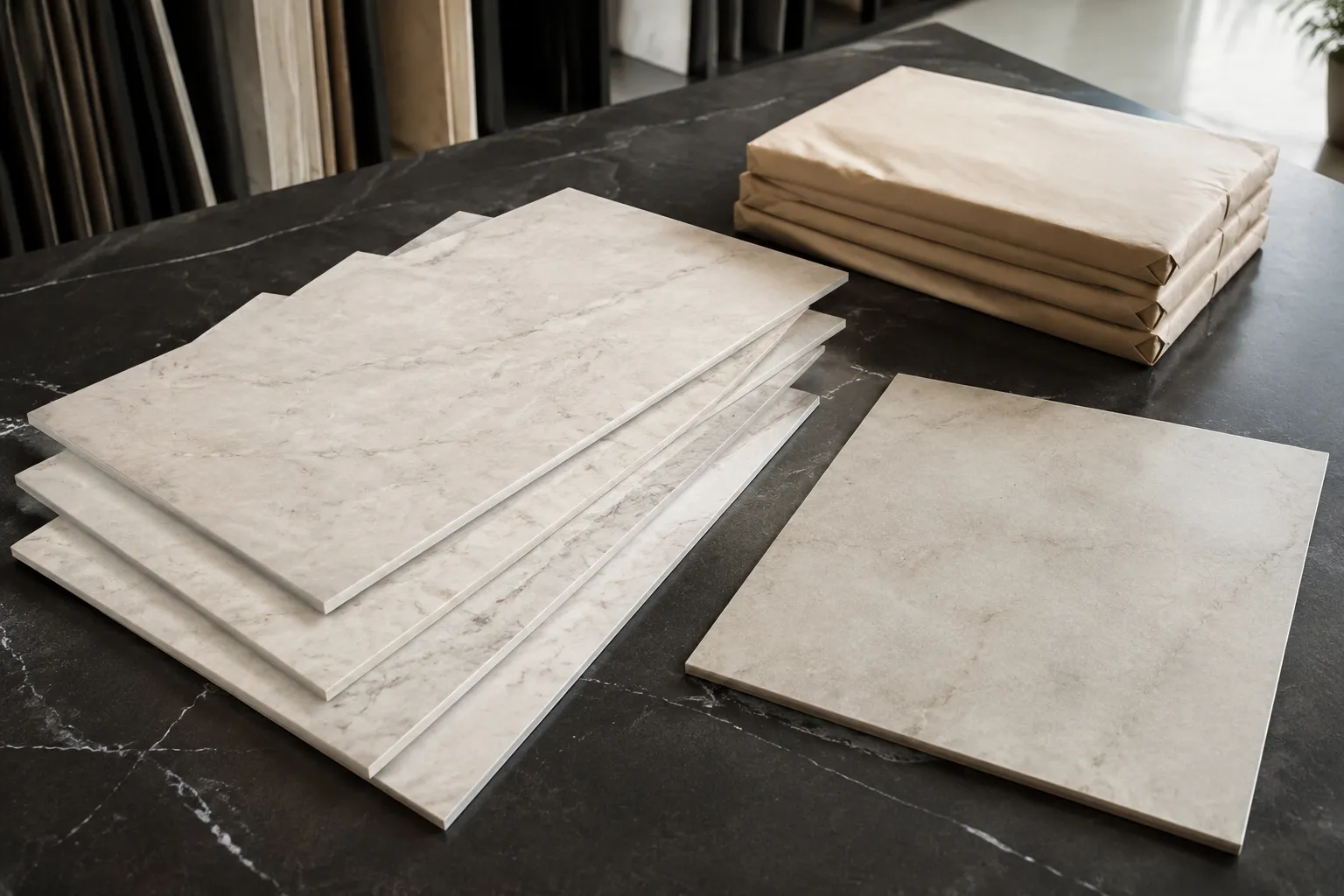
Every production run of tile carries its own shade and calibration. Natural stone goes further. Marble, Limestone, and Travertine come out of the earth with veining and tone that shift from block to block, which the Natural Stone Institute documents across every commercial stone variety. Variation is the beauty of the material, and it is also the reason the full quantity should ship together.
Hold back a box after installation as well. Keeping some extra tiles on hand turns a cracked tile two years from now into a one-hour repair instead of a hunt for a discontinued product. Future replacements match perfectly because they came from the same lot as the floor around them.
If marble makes your shortlist, plan for care as well as quantity, starting with our guide on how to clean marble tile the right way. And for grout upkeep down the road, our walkthrough of why tile grout cracks pairs well with those spare boxes.
Pre-order checklist
- ✓ Room dimensions measured twice, in feet, at the widest points.
- ✓ Irregular areas split into rectangular sections and added together.
- ✓ Tile dimensions confirmed, with square feet per single tile worked out.
- ✓ Wastage allowance matched to your tile layout and room shape.
- ✓ Window and door areas subtracted from wall calculations.
- ✓ Total tile count converted to full tile boxes.
- ✓ One spare box set aside for future repairs and replacements.
We walk clients through coverage and box counts before a single order goes in. Bring us your room dimensions and we will confirm the math against the exact tile you have chosen.The Cavastone team, Cavastone, Boca Raton, Florida
Ask AI about this guide
Why Cavastone
Since Connie Davalos founded Cavastone in 2006, our team has helped South Florida architects, interior designers, builders, and homeowners take projects from first measurement to final grout line. We source exclusive porcelain and natural stone directly from Spain and Italy, with collections you will not find through other South Florida suppliers.
Two warehouses carry over 600 SKUs, which support a 24- to 48-hour turnaround on stocked materials. Trade professionals receive trade pricing, homeowners receive retail pricing, and both get the same hands-on service, including job site visits when a project needs eyes on the ground. Samples and pricing come without hurdles because your calculations deserve real numbers.
Visit the Boca Raton showroom located at 646 Park of Commerce Way, Boca Raton, FL 33487, or call 561-994-9100 and bring your room dimensions with you.
Compare tile sizes in person and leave with an exact order plan for your space.
FAQ: Common Tile Calculation Questions
How do I calculate tile for a room?
Multiply the length and width of the room in feet to find the total square footage. Then divide that total area by the square footage one tile covers. Round up to the next whole tile, then add 10 to 15% for cuts and waste. The result tells you exactly how many tiles to order.
How much extra tile should I buy?
Plan on 10% extra for a straight tile layout on an open floor. Move to 15% for showers, backsplashes, and rooms with many corners or fixtures. Diagonal layouts and herringbone patterns call for 15 to 20% because every angled cut creates offcuts you cannot reuse.
How many 24 x 24 tiles do I need for 100 square feet?
Each 24 x 24 inch tile covers 4 square feet, so 100 square feet needs 25 tiles before waste. Add 10%, and you land at 28 tiles. Since tiles ship in boxes with fixed coverage, check the box size and round up to full boxes when you order.
Do grout lines change how many tiles I need?
Slightly, yes. Grout spacing means each tile plus its joint covers a little more area than the tile alone, which can trim the total tile count on large floors. Treat that as a small cushion rather than a number to count on. Waste from cut tiles almost always outweighs it.
Does tile size affect the amount of waste?
It does. Larger tiles cover more area with fewer pieces, but every trimmed piece removes more material, so edge cuts generate more waste. Smaller tiles produce less waste per cut and adapt better to tight or uneven surfaces, though they raise the total number of tiles and the labor time.
How do I calculate tile for walls with windows or doors?
Measure each wall separately, multiplying height by width. Then subtract the area of every window and door opening. If the subtraction returns a negative value, a measurement slipped, so re-measure before you order. A positive value gives you the true tiled surface for that wall.
Should I use a tile calculator or do the math by hand?
Both reach the same answer. The hand method in this guide shows you why the numbers work, which helps when a room gets complicated. A tile calculator turns your room dimensions and tile size into an instant estimate, so it saves time once you understand the method behind it.
Why should all my tiles come from the same production lot?
Tile shade and sizing shift slightly from one production run to the next. Ordering the full quantity at once, from a single lot, keeps color and dimensions consistent across the whole floor or wall. A later top-up order from a new lot may not match, even for the same product name.
Keep exploring
- Large Format Tile: A Guide to Sizes, Applications, and Installation
- Outdoor Tiles for Patio Spaces: Style, Safety, and Performance
- How Long Does Tile Installation Take? A Complete Timeline Guide
- Small Bathroom Tile Patterns That Make a Room Feel Bigger
- Tile Layout Patterns That Bring Spaces to Life
- How to Choose the Best Grout Color for Your Tile
Ready to Order the Right Quantity the First Time?
Send our team your measurements and the tile you love. We will confirm the square footage, the wastage allowance, and the exact box count before you calculate the tiles needed for a single order.

Owner, Cavastone Group
With years of perseverance and pride in what we do we have become a very well known and positioned company in the Architectural and Design industry. The same perseverance, pride and attention to detail that made us become who we are, are the same qualities we strive to provide to all our customers.