Large format tile has become a defining choice for modern interiors among architects, designers, and homeowners renovating kitchens, bathrooms, and commercial spaces across South Florida. Explore Cavastone’s porcelain slab collection to see current sizes, or use this guide to compare sizing standards, applications, and installation requirements before you start your search.
See large format tile and porcelain slabs in person at our Boca Raton showroom.
Quick Answer: What Is Large Format Tile?
Large format tile is any tile with one edge measuring 15 inches or longer, including porcelain slabs that can run close to 10 feet. It reduces visible grout lines and works well on floors, walls, and shower surrounds in both homes and commercial spaces. Because it is less forgiving of an uneven substrate than smaller tile, installation calls for stricter flatness standards and an experienced installer.
What You Should Know Before You Start
What Size Counts As Large Format Tile?
- Any tile with one edge measuring 15 inches or longer meets the industry definition, per ANSI A108.02.
- Common sizes include 12 × 24, 24 × 24, and 24 × 48 inches.
- Porcelain slabs push the definition further, reaching lengths close to 10 feet.
Does Large Format Tile Work In Every Room?
- Large format tile works well in kitchens, bathrooms, showers, entryways, and open living areas.
- Very small or oddly shaped rooms may need more cuts, which can raise both cost and waste.
- A curved staircase or a room full of tight corners often calls for a smaller tile instead.
Is Large Format Tile More Expensive To Install?
- Material costs vary by brand, size, and finish, so get a written quote for your project rather than assuming a fixed price.
- Labor costs tend to run higher, since installation takes more time, more precision, and often more than one installer.
- Fewer grout lines can simplify day-to-day cleaning, though sealing and upkeep needs still depend on the grout used.
Can You Install Large Format Tile Yourself?
- Large format tile needs a substrate flat to within 1/8 inch over 10 feet, a tolerance most DIY projects struggle to hit.
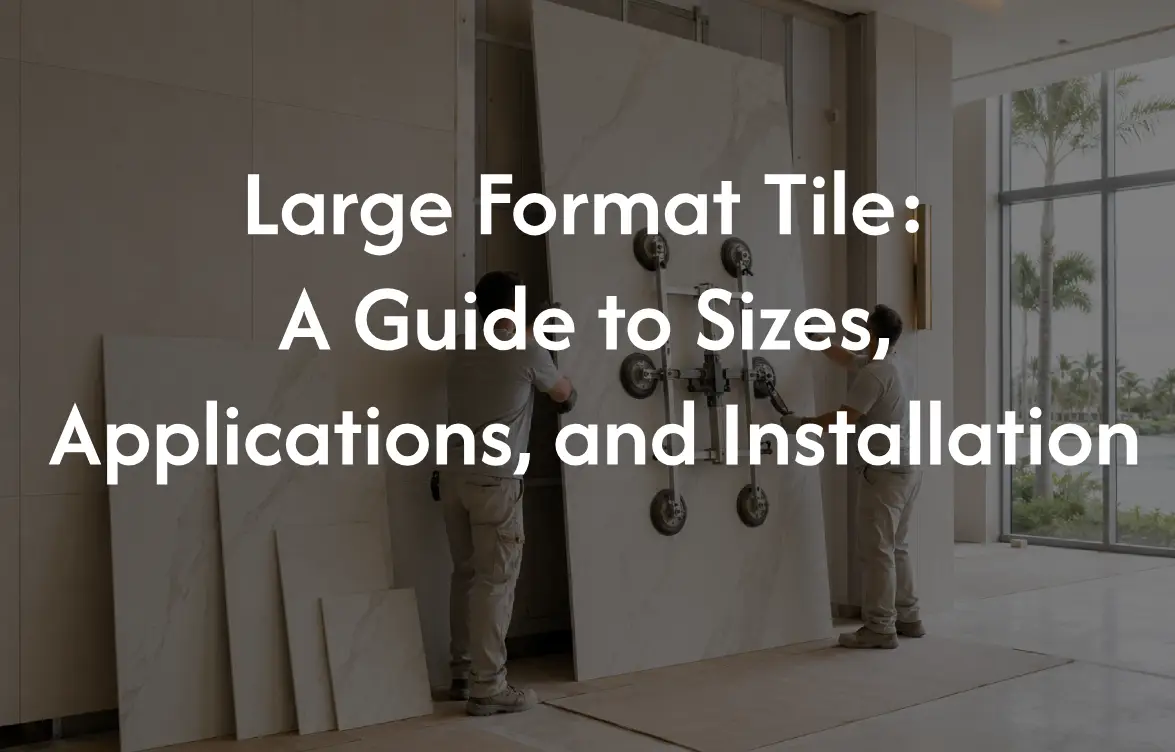
- The size and weight of large tile and porcelain slabs often call for two or more installers plus lifting equipment.
- Cavastone recommends working with a Certified Tile Installer for any large format project.
15 in.
Minimum edge length that qualifies as large format tile
1/8 in.
Maximum substrate flatness variation allowed over 10 feet
10 ft.
Approximate maximum length of large porcelain slabs
600+
SKUs in stock across Cavastone’s two South Florida warehouses
In This Guide
- What You Should Know Before You Start
- Large Format Tile Sizes and Definitions
- Residential and Commercial Applications of Large Format Tile
- Large Format Tile Vs. Small Tile
- Selecting Large Format Tile for Wet Areas
- Installation Requirements for Large Format Tile
- Cavastone’s Large Format Tile Sourcing and Support
- FAQ: Common Large Format Tile Questions
Large Format Tile Sizes and Definitions
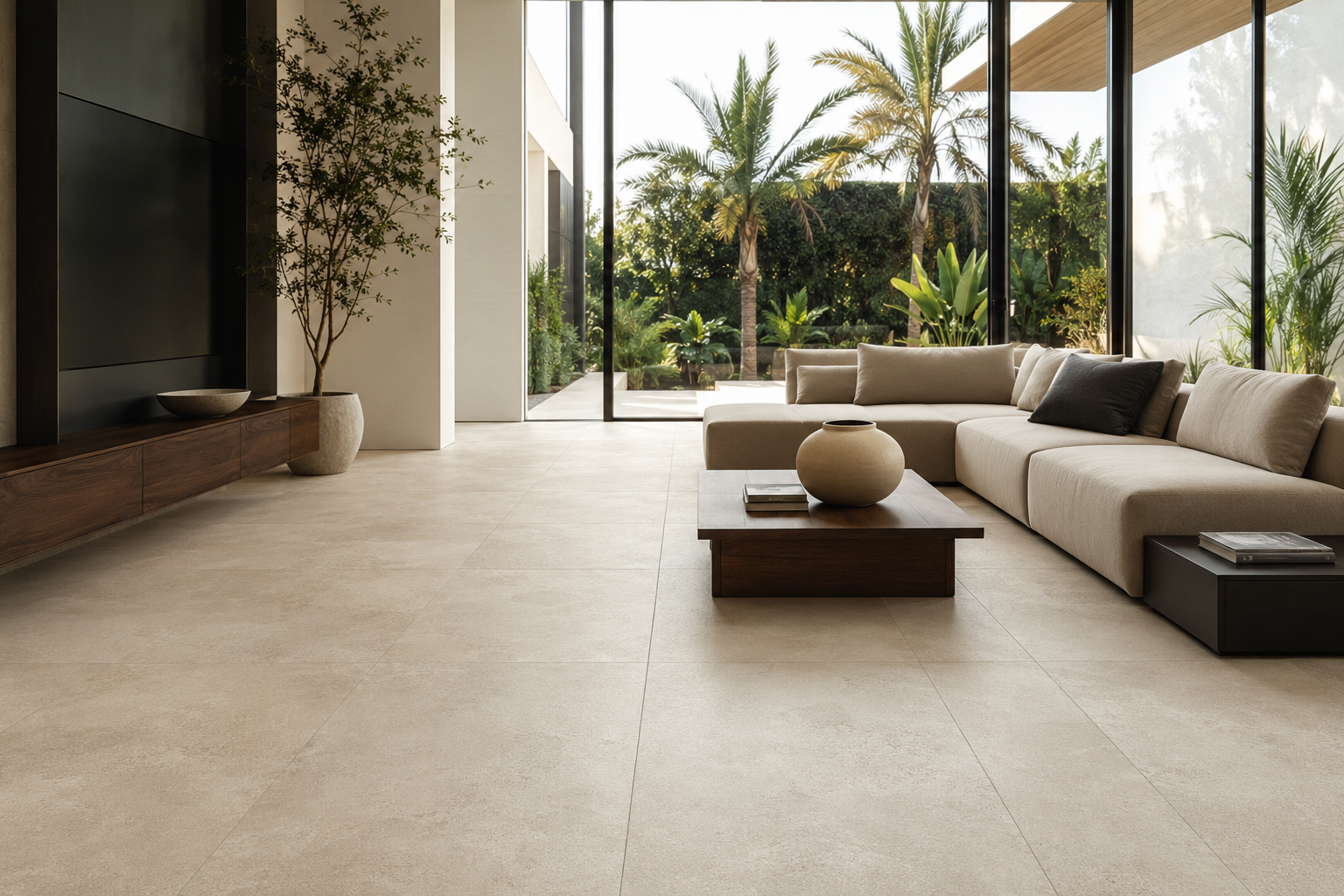 The tile industry defines large format tile as any tile with at least one edge measuring 15 inches or longer, a threshold documented by the Ceramic Tile Education Foundation under ANSI A108.02. Common sizes include 12 × 24 inches, 24 × 24 inches, and 24 × 48 inches.
Porcelain slabs, sometimes called gauged porcelain tile panels, extend well past that range, with some running close to 10 feet long in a single piece.
Ceramic and natural stone are also produced in large format sizes, though porcelain remains the most common choice for its combination of size, strength, and design options. Rectified tile, ground to a precise edge under ANSI A137.1, allows for the narrow grout joints most large format layouts call for.
Residential and Commercial Applications of Large Format Tile
Large format floor tile, wall tile, and shower surrounds all work well in both homes and commercial buildings. Fewer grout lines make it easier to keep clean, which is one reason it shows up so often in kitchens, primary bathrooms, and hotel lobbies.
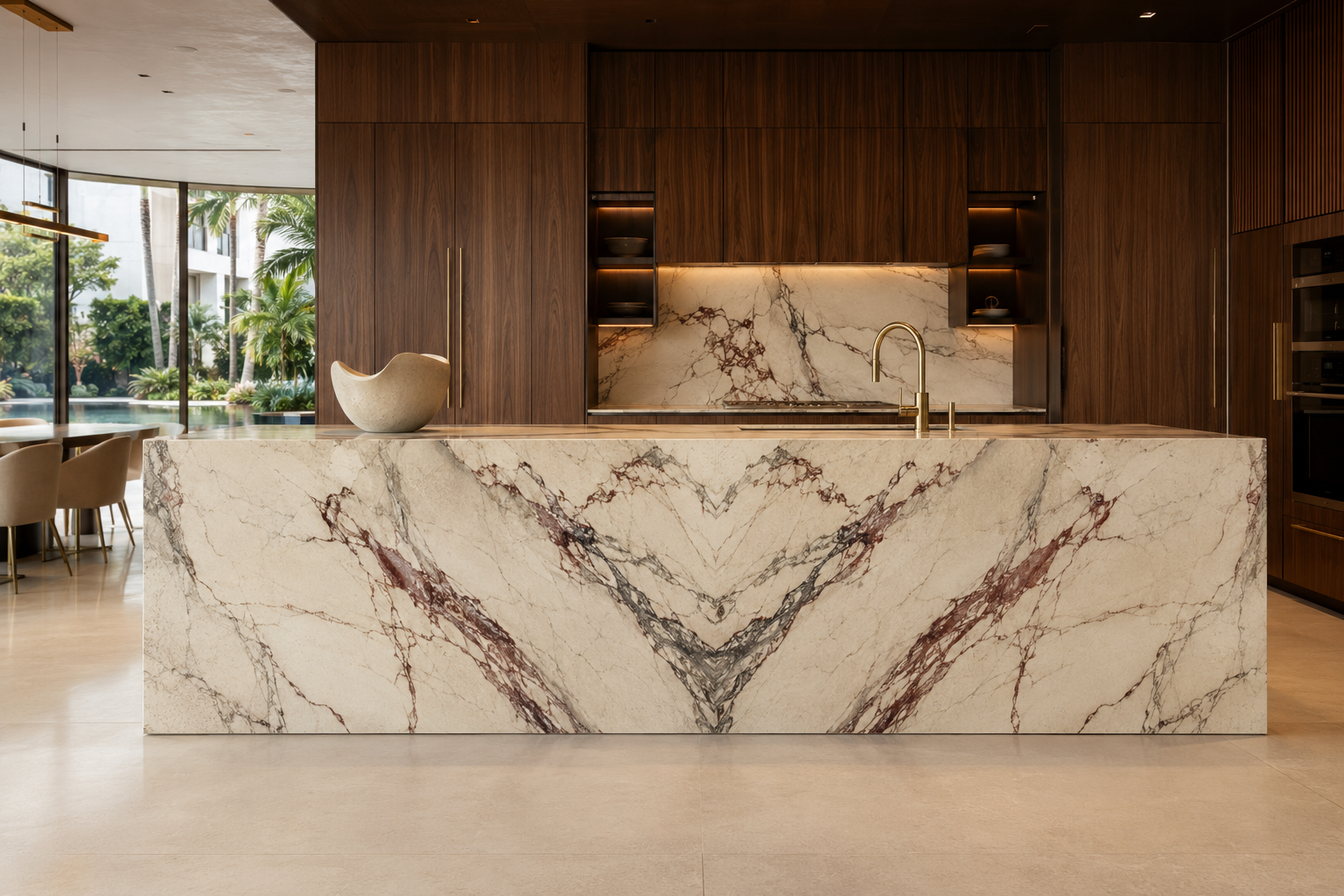
In residential projects, large floor tiles and large wall tiles reduce the choppy look of too many small pieces. A large format tile shower can extend from the floor up the walls for a more continuous line (see the wet-area section below before finalizing that layout), and a large format tile countertop built from large format porcelain tile covers a kitchen island in one or two pieces instead of a patchwork of seams. Porcelain pavers bring a similar look to an outdoor patio or pool deck.
Pro Tip
Measure every wall, niche, and corner before you order, and run the numbers through Cavastone’s tile calculator so you know roughly how much material to buy, plus extra to cover cuts and future repairs.
Commercial spaces benefit from the same properties. High-traffic lobbies, restaurants, and retail floors gain a denser, easier-to-maintain surface along with a more polished first impression. For heavy commercial traffic, ask about the tile’s PEI rating, which measures wear resistance.
Large Format Tile Vs. Small Tile
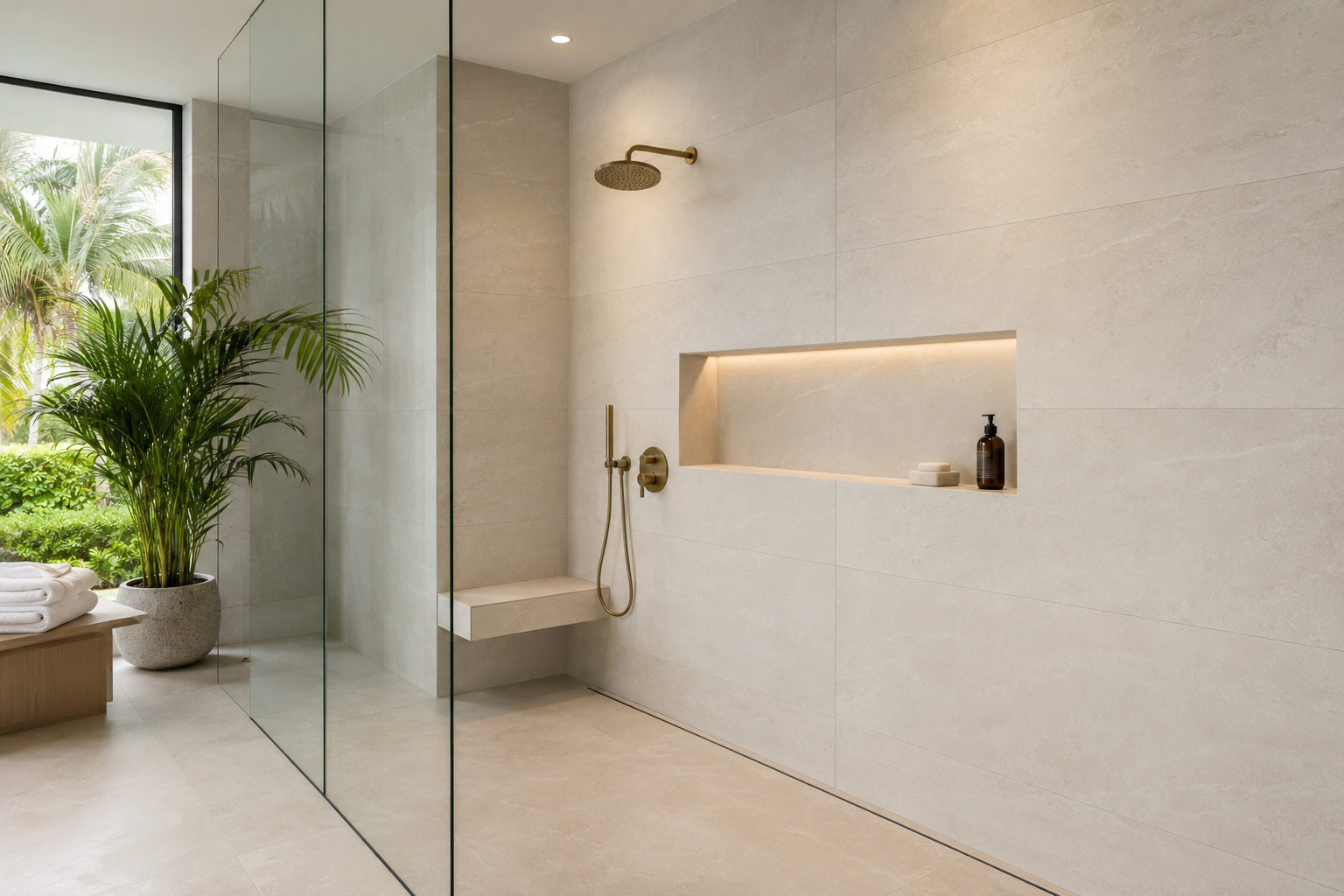 Large tile and small tile suit different situations. Large format tile works best in open floor plans, wide bathroom floors, and walls where a continuous surface is the goal, since fewer seams mean less visual clutter.
Small tile still has a place in tight spaces, curved showers, and floors with many drains or pipe penetrations. Mosaic and small-format tile also allow for patterns, such as herringbone or basketweave, that large format tile cannot recreate.
The tradeoff shows up in installation. Large tile requires a flatter substrate and more precise setting than small tile, so labor typically costs more per square foot. Material and labor costs both vary by size, brand, and finish, so get a quote from your installer rather than assuming a fixed difference.
Selecting Large Format Tile for Wet Areas
Choosing large format shower tile comes down to more than finish. Check the manufacturer’s declared use classification and the tile’s slip resistance rating before specifying any tile for a wet area.
Good To Know
The Tile Council of North America requires a wet dynamic coefficient of friction (DCOF) of 0.42 or higher for tile used in a level interior space that gets walked on wet. A smooth polished finish can fall short of this threshold, while a textured or matte finish more often meets it. The manufacturer’s published rating is the only reliable way to confirm it.
Running one large tile from a shower floor up the walls creates a clean line, but the floor still needs proper slope to the drain. An oversized tile may need factory-cut relief or a compatible linear drain to follow that slope without lippage at the transition. Confirm the drainage design with your installer before finalizing tile size for a shower floor.
Installation Requirements for Large Format Tile
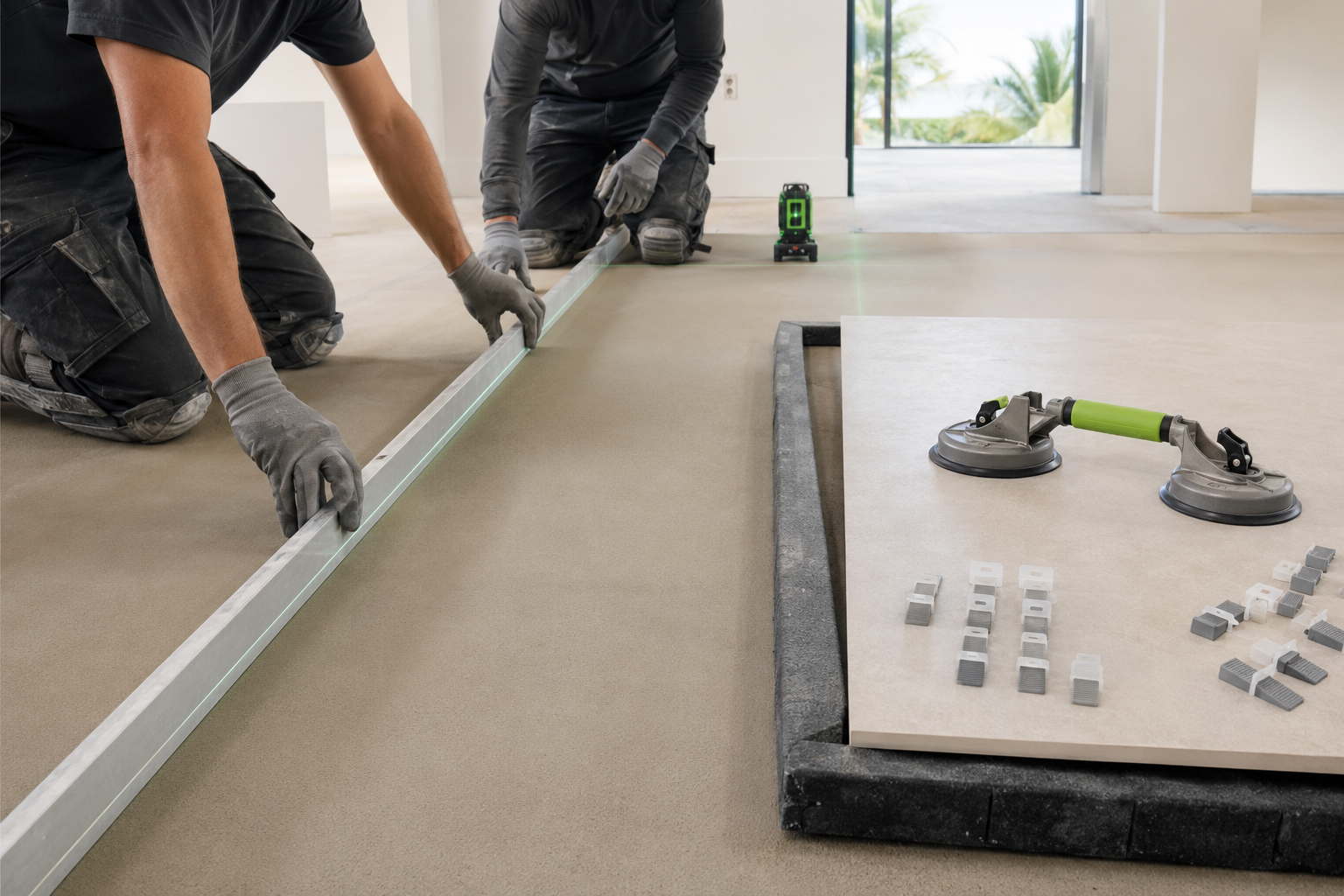 Because each large tile spans so much area, small dips or bumps in the substrate below show up as lippage, where one tile edge sits higher than its neighbor.
Under ANSI A108.02, the substrate for any tile with an edge 15 inches or longer must be flat to within 1/8 inch over 10 feet, tighter than the 1/4 inch allowed for standard tile. Meeting that standard typically requires grinding high spots and filling low spots with a cementitious patch or self-leveling underlayment, never thin-set mortar to level the surface itself.
Large-format tile is set with large-and-heavy-tile (LHT) mortar, formerly called medium-bed mortar, using a trowel sized per the manufacturer’s instructions. Mortar coverage on the back of the tile must reach at least 80% in dry areas and 95% in wet or exterior areas. Any large expanse of tile also needs a perimeter expansion joint where it meets a wall, tub, or change in plane, filled with flexible sealant rather than grout.
Watch Out
Poor substrate prep often leads to cracked tile and lippage after installation. Do not treat large format tile or porcelain slabs as a do-it-yourself weekend project. Review your site conditions with a Certified Tile Installer before you order material.
Given these requirements, large format tile is a job for an installer trained in the format. Cavastone recommends working with a Certified Tile Installer for any large format project.
Checklist: Before You Order Large Format Tile
- ✓ Confirm your substrate can be leveled to the tolerance your installer needs
- ✓ Order extra material as a waste factor to cover cuts and future repairs
- ✓ Check the tile’s DCOF rating and use classification for any wet area
- ✓ Bring home a full-size sample before you commit, not just a small chip
- ✓ Confirm current lead times and pricing with Cavastone
Large format tile rewards a little patience up front. Get the substrate flat and the mortar right, and the rest of the installation falls into place.
The Cavastone team
Ask AI about This Guide
Cavastone’s Large Format Tile Sourcing and Support
Cavastone was founded by Connie Davalos in 2006 and has sourced large format tile and porcelain slabs for South Florida architects, designers, and homeowners for nearly two decades.
Many of Cavastone’s large format porcelain collections are imported directly from Spain and Italy. Cavastone stocks more than 600 SKUs across two South Florida warehouses, with a 24-hour to 48-hour turnaround on stocked materials.
Cavastone’s team can walk through finish, size, and performance ratings while you are planning your project, and works with both trade professionals and homeowners at trade and retail pricing.
Visit the Boca Raton Showroom
646 Park of Commerce Way, Boca Raton, Florida 33487 | 561-994-9100
FAQ: Common Large Format Tile Questions
What Size Tile Counts As Large Format?
Any tile with one edge measuring 15 inches or longer is considered large format tile. That covers common sizes like 12 × 24, 24 × 24, and 24 × 48 inches, along with porcelain slabs that can run close to 10 feet. Some manufacturers use the term more loosely for marketing purposes, so always confirm the exact dimensions listed on the product specification sheet.
Is Large Format Tile Good For A Shower?
This scale of tile works well in showers when the tile’s slip resistance rating and the drainage design both suit a wet floor. A 12 × 24 tile is a popular shower size because it balances scale with the flexibility to handle corners and curbs without excessive cutting. Larger sizes also reduce the number of grout lines inside the shower enclosure, which many homeowners prefer for both looks and cleaning.
Do Large Tiles Make A Room Look Bigger?
Large tiles can make a room feel more open because fewer grout lines mean less visual clutter for the eye to process. A continuous run of tile across a floor or wall draws attention to the room itself rather than the flooring pattern. Light, low-contrast grout further reinforces this effect by keeping the seams from standing out.
Does Large Format Tile Need Special Installation?
Yes. This scale of tile requires a substrate flat to within 1/8 inch over 10 feet, large-and-heavy-tile mortar, and thorough coverage on the back of every piece. Working with a Certified Tile Installer helps avoid the lippage and cracking that come from cutting corners on substrate prep. Ask your installer which of these steps apply to your project before work begins.
What Is The Difference Between Large Format Tile And Porcelain Slabs?
Porcelain slabs are a category within large format tile, at the largest end of the range. Standard sizes typically top out around 24 × 48 inches, while porcelain slabs can stretch close to 10 feet in a single piece. Some manufacturers use the term gauged porcelain tile panel for slabs of 11 square feet or larger, under the ANSI A137.3 standard.
Does Large Format Tile Cost More Than Standard Tile?
Material costs vary by brand, size, and finish, so a written quote for your project is more reliable than a general estimate. Labor typically costs more than it does for standard tile, since this scale of tile takes more time, more precision, and often more than one installer to set correctly. Ask your installer for an itemized quote that separates material and labor, since the split between the two varies by project.
What Grout Joint Width Does Large Format Tile Need?
Grout joint width for large format tile typically ranges from 1/16 inch for rectified tile to 3/16 inch or more for tile with a pressed, non-rectified edge. Rectified tile allows a narrower joint because its edges are ground to a precise, consistent dimension. The manufacturer’s installation instructions set the minimum joint width for a given tile, so confirm this before finalizing a layout.
Can Large Format Tile Be Installed Over Existing Tile?
In most cases, no. Large format tile needs a substrate flat to within 1/8 inch over 10 feet, and an existing tiled floor with its own grout lines and lippage rarely meets that standard. The added height from a second layer can also create transition problems at doorways and thresholds. Most installers remove the old tile and start with a clean, prepped subfloor, though an installer can confirm whether your existing floor is an exception.
How Do You Clean And Maintain Large Format Tile?
Porcelain large format tile is low maintenance because of its dense, non-porous surface, which does not require sealing the way some grout and natural stone do. Regular sweeping and a pH-neutral tile cleaner handle most day-to-day care. Avoid acidic or abrasive cleaners, which can dull certain finishes over time. Because there is less grout overall, upkeep is generally simpler than it is with smaller tile.
Is Large Format Tile Heavier Than Standard Tile?
Large format tile and porcelain slabs weigh more per piece than standard tile, though weight per square foot is often similar since large format tile is commonly manufactured thinner. For upper-floor installations or full-slab wall applications, check the substrate’s load capacity and confirm the wall or floor can support the material before you order.
What Finish Options Are Available For Large Format Tile?
Large format tile comes in matte, polished, and textured finishes, each suited to different rooms and traffic levels. A matte or textured finish tends to hide water spots and offer better slip resistance in wet areas, while a polished finish reflects more light in a lower-traffic room. Our guide to matte, glossy, and textured tile compares each option in more depth.
Does Cavastone Stock Large Format Tile For Fast Turnaround?
Cavastone carries in-stock large format tile and porcelain slabs across two South Florida warehouses, with a 24-hour to 48-hour turnaround on stocked materials, compared to lead times of 10 to 12 weeks that are common for special-order sizes elsewhere in the industry. Contact Cavastone to confirm current availability for a size or finish.
Keep Exploring
Ready to Bring Large Format Tile Into Your Project?
Cavastone’s team can help you compare sizes, finishes, and performance ratings before you order.

Owner, Cavastone Group
With years of perseverance and pride in what we do we have become a very well known and positioned company in the Architectural and Design industry. The same perseverance, pride and attention to detail that made us become who we are, are the same qualities we strive to provide to all our customers.