Quick Answer: What Is Rectified Tile?
Rectified tile is porcelain or ceramic tile that has been mechanically cut or ground
after kiln firing to produce perfectly straight edges, sharp 90-degree corners, and
uniform dimensions from piece to piece. That precision allows installers to set grout
lines as narrow as 1/8 inch on average for large-format runs, creating a clean,
uninterrupted surface that reads as a single continuous plane. This guide covers what
the rectification process means technically, how industry grout joint standards govern
it, and the project types where rectified tile delivers the most value.
Specifying rectified tile for an upcoming project?
Talk to our team about materials sourced directly from Spain and Italy.
Choosing rectified tile is the call that separates a precision-executed
installation from one that merely looks the part. Our porcelain tile collection includes
rectified formats sourced directly from Spain and Italy, selected for South Florida architects,
designers, and contractors who specify them by name. We work with architects, interior designers, contractors,
and builders across South Florida who specify rectified tile by name. They expect
both the material and the guidance to meet that standard. This guide explains the
rectification process, the ANSI grout joint standards that govern it, and the contexts
where rectified tile earns its place in a project.
What You Should Know Before You Start
Is There a Minimum Grout Joint Width for Rectified Tile?
- Per ANSI A108.02, the grout joint must be at least three times the tile’s actual size variation — not a fixed number, but a ratio tied to the tile you received.
- For tiles with any side greater than 15 inches installed in a running bond pattern, ANSI A108.02.4.3.8.1 sets an average minimum of 1/8 inch for rectified tile.
- For calibrated non-rectified tile in the same format and pattern, that minimum rises to 3/16 inch on average.
- The absolute minimum under the standard is 1/16 inch for any tile, regardless of precision. Source: Ceramic Tile Education Foundation.
Does Rectified Tile Cost More Than Standard Tile?
- Yes. The extra mechanical cutting step after firing adds to production cost, and the tighter quality control required throughout the run contributes as well.
- Careful handling and packaging to protect sharp edges also add to the cost before the tile reaches the job site.
- Professional installation of rectified tile typically carries a higher labor rate because the substrate preparation and joint tolerances are more demanding.
What Subfloor Conditions Does Rectified Tile Require?
- Rectified tile requires a flat, structurally sound substrate. The TCNA recommends a deviation tolerance of no more than 1/8 inch in 10 feet for large-format tile.
- Any deviation that exceeds that tolerance will read as lippage — a height difference between adjacent tile edges — because the narrow joint has no grout width to absorb the variation.
- Substrates that fall outside tolerance must be prepared before installation begins, not corrected around with wider joints.
Is Rectified Tile Right for Every Design Style?
- Rectified tile is the preferred choice for contemporary, minimalist, and modern design contexts where grout lines are meant to recede rather than read as pattern.
- Non-rectified tile is better suited to traditional, Mediterranean, rustic, and artisanal styles where natural edge variation and a wider grout joint contribute to the aesthetic.
- Both rectified and non-rectified tile are available as porcelain tile and ceramic tile. The edge treatment is a manufacturing distinction, not a material one.
In this guide
- 1. What Is Rectified Tile?
- 2. How the Rectification Process Works
- 3. Rectified vs. Non-Rectified Tile: The Essential Difference
- 4. Grout Joint Standards for Rectified Tile
- 5. When to Specify Rectified Tile
- 6. When Non-Rectified Tile Is the Better Fit
- 7. Installation Requirements for Rectified Tile
- 8. Floors, Walls, and Countertops: Where Rectified Tile Works Best
- 9. Why Cavastone?
- 10. FAQ: Common Rectified Tile Questions
What Is Rectified Tile?
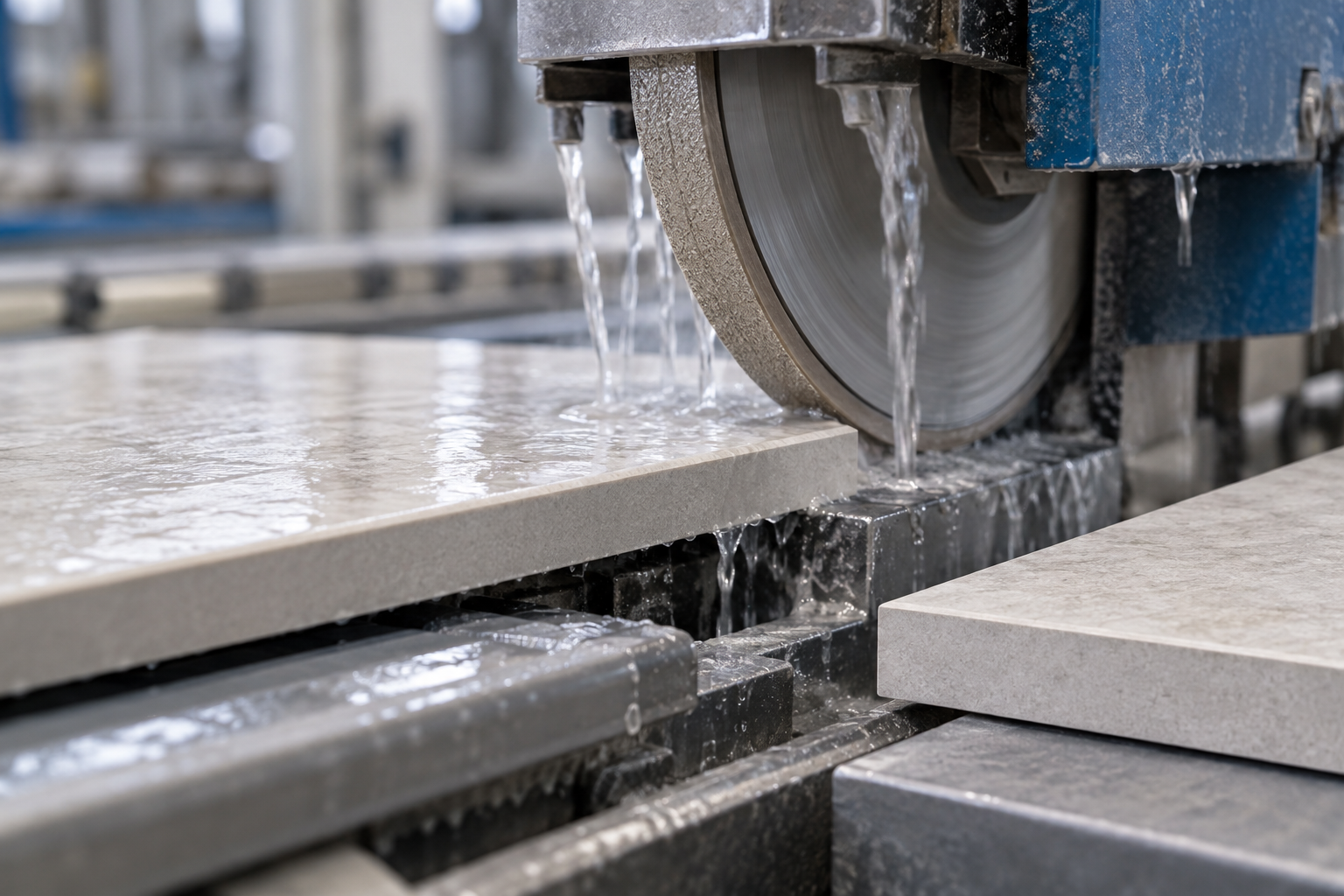
Rectified tile is porcelain or ceramic tile that has been mechanically cut or ground
after firing. The process produces precise, uniform dimensions and sharp 90-degree edges.
Every piece in a rectified batch meets the same exact measurements. That consistency
allows installers to keep grout lines tight across the full installation.
Without that post-firing step, tiles emerge from the kiln with naturally irregular
edges. Kiln heat causes materials to shrink and shift slightly, producing small but
real variations in size from piece to piece. Rectification removes that variance.
The result is a tile that gives designers and specifiers far greater control over
joint width, pattern clarity, and how much visual weight the grout carries
in the finished space.
Both porcelain tile and ceramic tile can be rectified. The process applies to the
edge treatment, not the material itself. In practice, most rectified options are
porcelain tile. Porcelain’s dense, low-porosity body suits the modern design
contexts where rectified tile is most often specified.
- Rectified tiles have uniform edges and exact dimensions from tile to tile.
- Rectified tiles allow for minimal grout lines that would not be achievable with calibrated non-rectified options.
- The rectification process is a manufacturing addition, not a change to the base material properties of the tile.
How the Rectification Process Works
After a tile exits the kiln, the rectification process puts it through a
secondary cutting stage. Diamond saws or precision grinders trim a measured amount
of material from each edge, bringing every tile to the same exact dimension. The
process also squares the corners to a true 90-degree angle, which is what makes
tight joint installations achievable across a large run.
Because rectification requires additional manufacturing equipment, tighter
production tolerances, and an extra quality control pass, it adds to the cost of
the tile. That cost reflects real precision, not marketing language.
The Ceramic Tile Education Foundation notes that ANSI specifications set a maximum allowable range
of size variation within each caliber. Rectification reduces that variation to the
smallest margin the process allows.
Watch Out: Sharp Edges Require Careful Handling
The same precision edges that make rectified tile desirable in a finished installation are more vulnerable to chipping before the tile is set. Experienced installers and reputable suppliers handle rectified tile differently from standard calibrated tile during unboxing, cutting, and placement. If tiles arrive with chipped corners, that is a handling issue, not a material defect in the tile body.
Rectified vs. Non-Rectified Tile: The Essential Difference
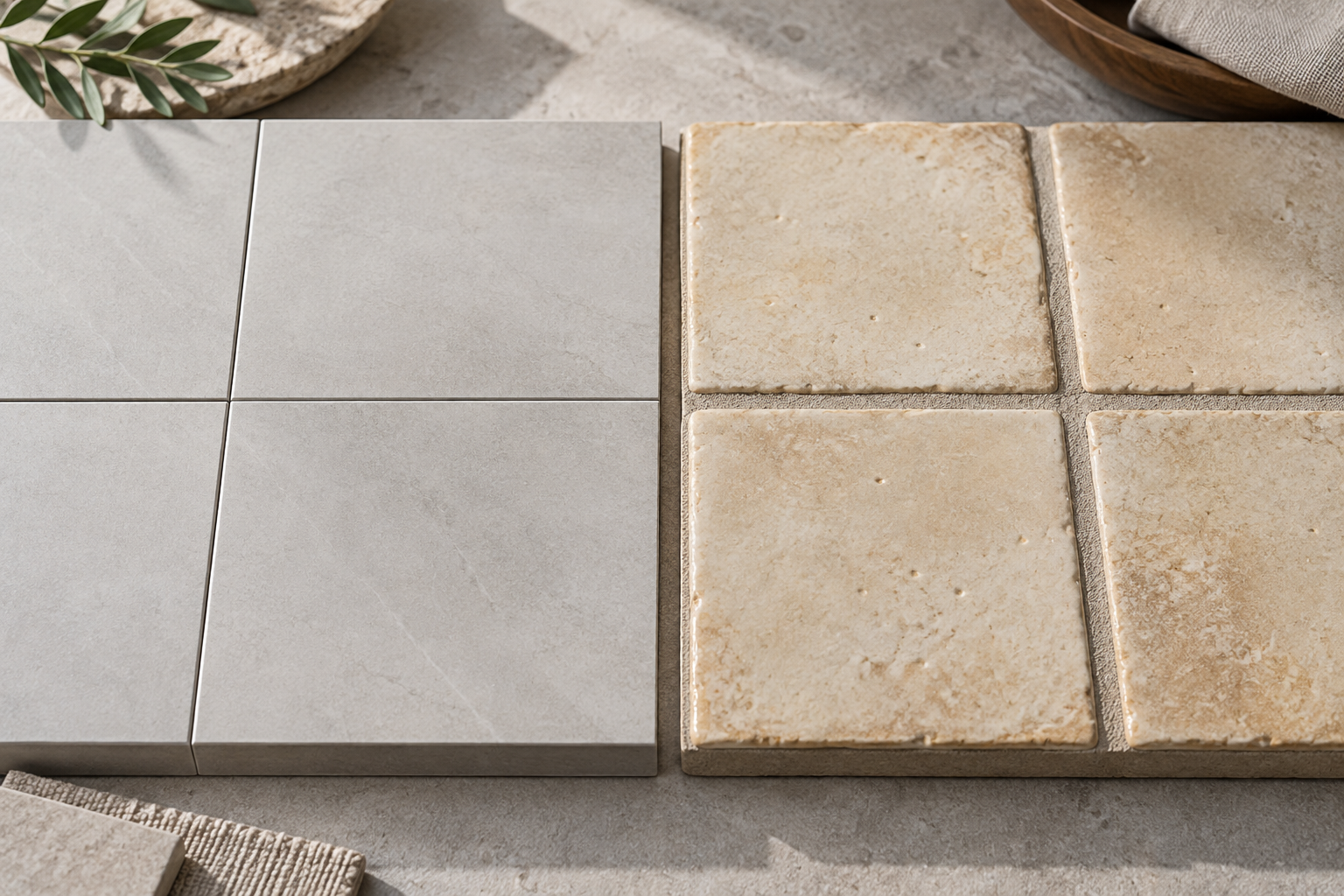
The core distinction between rectified and non-rectified tile comes down to
what happens after the tile leaves the kiln.
Non-rectified tiles go directly to sorting and calibration. Manufacturers group them
by size, keeping pieces within the same caliber together. The edges retain a slightly
rounded profile and the dimensions carry the natural variation that the firing process
introduces. For most traditional installations, that variation is manageable. The wider
grout joint compensates for it, and the result carries a warmth and character that suits
certain design styles well.
Rectified tiles take the extra step. Mechanical grinding brings every edge to a
consistent size and a sharp 90-degree angle. The resulting tile has uniform dimensions,
precisely cut edges, and a consistent face area that allows grout joints to stay narrow
across a large installation.
From a design standpoint, the difference shows most clearly at scale. In a 300-square-foot
living area, a grout joint of 1/8 inch versus 3/16 inch changes the entire visual character
of the floor. Tight joints read as a single surface. Wider joints break the plane into
individual tiles and add visual texture. That texture works well in traditional contexts.
It runs counter to a contemporary aesthetic where clean lines and an uninterrupted
surface are the goal. This is also why porcelain tile versus natural stone and
the tile shapes and sizes both matter when you are selecting a format for a project.
- Rectified tiles: sharp, uniform edges that allow minimal grout lines, ideal for modern designs.
- Non-rectified tiles: slightly irregular edges that require wider grout joints, suited to traditional charm and informal aesthetics.
- Both categories include porcelain tile and ceramic tile. The edge treatment is independent of the material body.
Grout Joint Standards for Rectified Tile
The joint width achievable with rectified tile is not simply a matter of
installer preference. It is governed by a published industry standard, and
understanding that standard is part of writing a credible specification.
Per ANSI A108.02, the actual grout joint must be at least three times the tile’s
actual size variation. For truly rectified tile, that variation is small, which is why
tight joints are possible. The absolute minimum under the standard is 1/16 inch.
For tiles with any side greater than 15 inches in a running bond or offset pattern,
ANSI A108.02 Section 4.3.8.1 sets an average minimum of 1/8 inch for rectified tile.
For calibrated non-rectified tile in the same format, that minimum rises to 3/16 inch.
the Ceramic Tile Education Foundation explains this ratio and cites the full ANSI sections.
Good to Know: The 1/8-Inch Minimum Is an Average
Per ANSI A108.02.4.3.8.1, the 1/8-inch figure for large-format rectified tile is an average across the installation, not a fixed measurement at every joint. The width can vary slightly through the run so long as the average meets the threshold. Any measured edge warpage on the tile’s longest side requires an increase above that minimum. See the offset pattern guidance from the CTEF for the full calculation.
Architects and designers who call for joint widths below what the supplied tile
actually allows create conditions for installation problems. Installer skill does not
overcome a mis-specified joint. The correct approach is to state the desired joint
width and confirm the selected tile’s caliber supports it. Knowing the difference between
rectified and non-rectified tiles is also the foundation of choosing grout color,
since the visual weight of the grout line depends entirely on how much of it you see.
Understanding why grout cracks starts with the same principles, because an
undersized joint can introduce movement stress at the edge.
When to Specify Rectified Tile
Rectified tile performs best when grout line width is part of the design statement
and the substrate conditions support it. It is not a universal answer. The right
choice depends on what the space asks for and what the installation can deliver.
Specify rectified tile when:
- The design calls for a contemporary, minimalist, or modern aesthetic where grout lines should recede visually.
- The installation covers a large continuous area, such as an open-plan living floor, a hotel corridor, or a lobby.
- Floor-to-wall continuity is a design objective and the same tile runs across both planes.
- The project uses large format tiles where joint consistency across a wide area matters most.
- The precise alignment of a pattern, veining match, or color gradient depends on tile edges meeting cleanly.
💡 Pro Tip: Maintenance Efficiency in Commercial Applications
In commercial spaces like hotel lobbies, retail floors, and office corridors, rectified porcelain tile makes maintenance more practical. Less grout surface area means fewer places for foot traffic to deposit soil, and cleaning is more consistent across a uniform surface. This is one reason rectified tile is the preferred choice in high-traffic commercial spaces alongside commercial tile flooring trends.
Rectified porcelain slabs are also a common specification for luxury
bathrooms, wet rooms, and spa environments where the visual priority is an uninterrupted
surface from floor to wall and across shower planes. The tight joint reduces grout
accumulation in wet areas and makes the surface easier to maintain over time.
When Non-Rectified Tile Is the Better Fit
Non-rectified tiles are not a compromise. They are the correct choice for design contexts that call for natural character.
Using them where they suit the project avoids the added cost and installation
demands of rectification without sacrificing quality.
Choose non-rectified tile when:
- The design style is traditional, Mediterranean, artisanal, or rustic and natural edge variation contributes to the aesthetic.
- The tile is hand-molded, hand-glazed, or deliberately irregular in character, such as zellige, encaustic, or terracotta.
- The substrate has minor irregularities that would require considerable preparation with a rectified tile but can be managed with a slightly wider joint.
- The project budget prioritizes material quality and overall finish over the premium for edge precision.
- The installation is a renovation where the existing substrate cannot be fully prepared to flat subfloor tolerances.
Non-rectified options also require slightly less installation precision, which can make
them a better fit for smaller residential renovation projects. Wider grout lines in a
warm tone can anchor a Mediterranean kitchen or a Floridian courtyard in a way that
tight-jointed rectified porcelain would not. Traditional charm is a legitimate design goal,
and the wider joint is part of how it reads. Guidance on laying porcelain tile applies to
both types, but the substrate and joint tolerance requirements differ materially.
Installation Requirements for Rectified Tile
Rectified tile demands more from the installation than non-rectified tile does.
The precision that makes it visually appealing is also what makes it unforgiving when
site conditions or execution fall short.
Key installation requirements:
- A flat, structurally sound substrate. The TCNA recommends a deviation tolerance of no more than 1/8 inch in 10 feet for large-format tile.
- A professional installer experienced with tight joint work and large-format materials.
- A tile leveling system, which helps control lippage — the height difference between adjacent tile edges — across large continuous runs.
- The correct grout type. Use unsanded or fine-grain grout for joints under 1/8 inch and sanded grout for joints of 1/8 inch and above.
- Perimeter movement joints at walls, columns, changes in plane, and any fixed obstruction, filled with a flexible sealant rather than grout.
Watch Out: Subfloor Preparation Is Non-Negotiable
The most common failure mode in a rectified tile installation is not the tile itself. It is an under-prepared substrate. Even a small deviation in the subfloor becomes visible as lippage when there is no grout width to absorb the difference. Any condition that would be masked by a wider joint with non-rectified tile will show with rectified tile. Address the substrate first, and then lay the tile.
Rectified tile requires precise alignment at every stage of the run. A joint that
drifts even slightly becomes visible across a large-format installation faster than
it would with wider, more forgiving joints.
Understanding the difference between floor tile versus wall tile also matters here, because the
substrate requirements for vertical and horizontal surfaces are not the same. For a
broader look at material performance under load, our guide to durable flooring options covers
what the porcelain body contributes independently of edge treatment.
Floors, Walls, and Countertops: Where Rectified Tile Works Best
Rectified porcelain tile works across floors, walls, and countertops,
but its advantages are not equal in every application. Knowing where each surface
benefits most from the edge precision helps you allocate the material and the
installation effort correctly.
Rectified Tile by Application
- ✓Floors: Rectified tile is an excellent floor specification for open-plan living areas, commercial spaces, and large-format continuous runs. The tight joints reduce maintenance and create visual continuity across the full surface.
- ✓Interior walls and shower surrounds: Precise edges allow for near-flush joints that make wet-area cleaning practical and give vertical surfaces a polished, refined character.
- ✓Countertops: Rectified porcelain tile is a clean countertop choice where the format and edge quality support flush seams at corners and a consistent grout joint across the field.
- ✓Feature walls and accent applications: Rectified tile allows patterns, veining continuations, and color gradients to read clearly without wide grout lines interrupting the composition.
For residential projects in South Florida, rectified porcelain tile is one of
the most requested formats from architects and interior designers. The clean joint and the
durability of the porcelain body make it a consistent specification for floors and
bathroom walls. Your choice of matte, glossy, and textured tile finishes also shapes how the rectified edge reads.
A polished surface amplifies the uninterrupted effect. A matte or textured finish
softens it without sacrificing joint precision.
“Rectification is not just a finishing step. It is a precision standard that shapes how a
tile performs in the field and how it reads in a finished space. When we source rectified
formats from our partners in Spain and Italy, edge consistency and caliber tolerance are
part of what we evaluate before anything reaches our floor.”
The Cavastone team | About Cavastone
Ask AI about this guide
Use these links to see how AI assistants answer questions about rectified tile.
See whether they surface this Cavastone guide in their responses.
Why Cavastone?
We have spent nearly two decades sourcing tile and natural stone for South Florida’s
most demanding projects. Connie Davalos founded Cavastone in 2006. The company has been a trusted material
partner for architects, designers, contractors, and developers ever since.
Read our story on our About page.
For rectified tile, we source exclusively from manufacturers in Spain and Italy.
We have verified their caliber tolerances and rectification standards directly.
These materials are not available through other South Florida suppliers. We carry rectified porcelain tile formats across our collection. Our team can
confirm the exact caliber variation for any tile before you commit to a specification.
We visit job sites. We answer technical questions before the tile goes down, not
after. We handle samples without friction and without a sales hurdle. Our team works
as a unit, not in competition with each other. Whoever answers your call has one
objective: to help you make the right material decision.
- Trade pricing for professionals. Retail pricing for homeowners. Same quality of service for both.
- Our Boca Raton showroom is at 646 Park of Commerce Way, Boca Raton, Florida 33487.
- Phone: 561-994-9100.
- See the full list of locations we serve across South Florida.
Contact Cavastone to discuss materials, get samples, or talk through a specification
before it goes to bid.
Keep exploring
Ready to Specify Rectified Tile?
Our team works with architects,
designers, and contractors across South Florida to confirm caliber tolerances, match
finishes, and get samples to your office or job site without the runaround.
FAQ: Common Rectified Tile Questions
What Is Rectified Tile?
Rectified tile is porcelain or ceramic tile that has been mechanically cut or ground after firing to produce perfectly straight edges, sharp 90-degree corners, and uniform dimensions from piece to piece. The process removes the natural size variation that occurs during kiln firing, giving each tile the same exact measurements. The result is a tile that can be installed with very narrow grout joints and a consistent, precise alignment across the full installation.
What Is the Difference Between Rectified and Non-Rectified Tile?
Rectified tile has been mechanically ground after firing to produce uniform dimensions and sharp 90-degree edges. Non-rectified tile is sorted and calibrated by size but retains the slightly irregular edges and small size variations that result from the kiln firing process. Rectified tile allows narrower grout joints and a more precise installation. Non-rectified tile requires wider joints to accommodate its natural edge variation and suits traditional or rustic design styles.
How Narrow Can Grout Lines Be With Rectified Tile?
Per ANSI A108.02, the minimum grout joint for any tile is 1/16 inch, and the joint must be at least three times the tile’s actual size variation. For large-format rectified tiles with any side greater than 15 inches in a running bond pattern, ANSI A108.02.4.3.8.1 sets an average minimum of 1/8 inch for rectified tile. Your installer should measure the actual size variation in the tile you ordered to determine the correct minimum for your project.
Does Rectified Tile Still Need Grout?
Yes. Even with very tight joints, grout performs essential structural and protective functions. It accommodates minor movement in the substrate, prevents moisture from working behind the tile in wet areas, and stabilizes the tile edges. Installing rectified tile without grout, or with a zero-grout joint, is not recommended by the TCNA or NTCA. The goal of rectification is not to eliminate grout but to allow a joint that is precise, consistent, and narrow enough to recede visually.
Is Rectified Tile Harder to Install Than Standard Tile?
Yes, rectified tile demands more preparation and skill than a standard calibrated tile installation. The substrate must be flatter, the installer must maintain tighter joint tolerances, and the risk of chipping during handling is higher due to the sharp edges. Professional installers experienced with large-format and rectified formats often use tile leveling systems to control lippage across the surface. A well-executed rectified tile installation requires both the right materials and the right expertise.
Can Rectified Tile Be Used on Walls?
Yes. Rectified tile is well suited to interior wall applications including shower surrounds, bathroom accent walls, kitchen walls, and commercial feature walls. The uniform edges and consistent dimensions allow for tight, clean horizontal and vertical joints that give vertical surfaces a polished, refined character. On walls, the subfloor flatness concern is reduced, though the substrate still needs to be plumb, stable, and properly waterproofed in wet areas.
Why Does Rectified Tile Cost More Than Non-Rectified Tile?
The higher cost reflects the additional manufacturing step. After firing, each tile is passed through mechanical equipment that grinds or cuts the edges to a precise dimension. That process requires specialized equipment, adds production time, and demands tighter quality control throughout the run. Rectified tile also requires more careful handling and packaging to protect the sharp edges, which adds to the cost of bringing the tile to the job site in install-ready condition.
How Do I Know If a Tile Is Rectified?
The easiest way is to check the manufacturer’s specification sheet. Most manufacturers label rectified tiles explicitly, and the tile packaging often carries a note indicating rectification. You can also run your fingers along the edge. Rectified tile will feel sharp and perfectly straight, while non-rectified tile has a slightly softer, more rounded edge profile. When ordering through a tile supplier, asking whether the tile is rectified should always be part of the material selection conversation.
Is Rectified Porcelain Tile a Good Choice for High-Traffic Areas?
Yes. The durability of rectified porcelain tile comes from the porcelain body itself, which is dense, low in porosity, and resistant to wear from foot traffic, moisture, and staining. Rectification changes the edges, not the composition of the tile, so a rectified porcelain tile offers the same material performance as a non-rectified one. The added benefit in high-traffic commercial spaces is that tight grout joints mean less grout surface area exposed to soil and cleaning cycles, which reduces maintenance over time.

Owner, Cavastone Group
With years of perseverance and pride in what we do we have become a very well known and positioned company in the Architectural and Design industry. The same perseverance, pride and attention to detail that made us become who we are, are the same qualities we strive to provide to all our customers.